
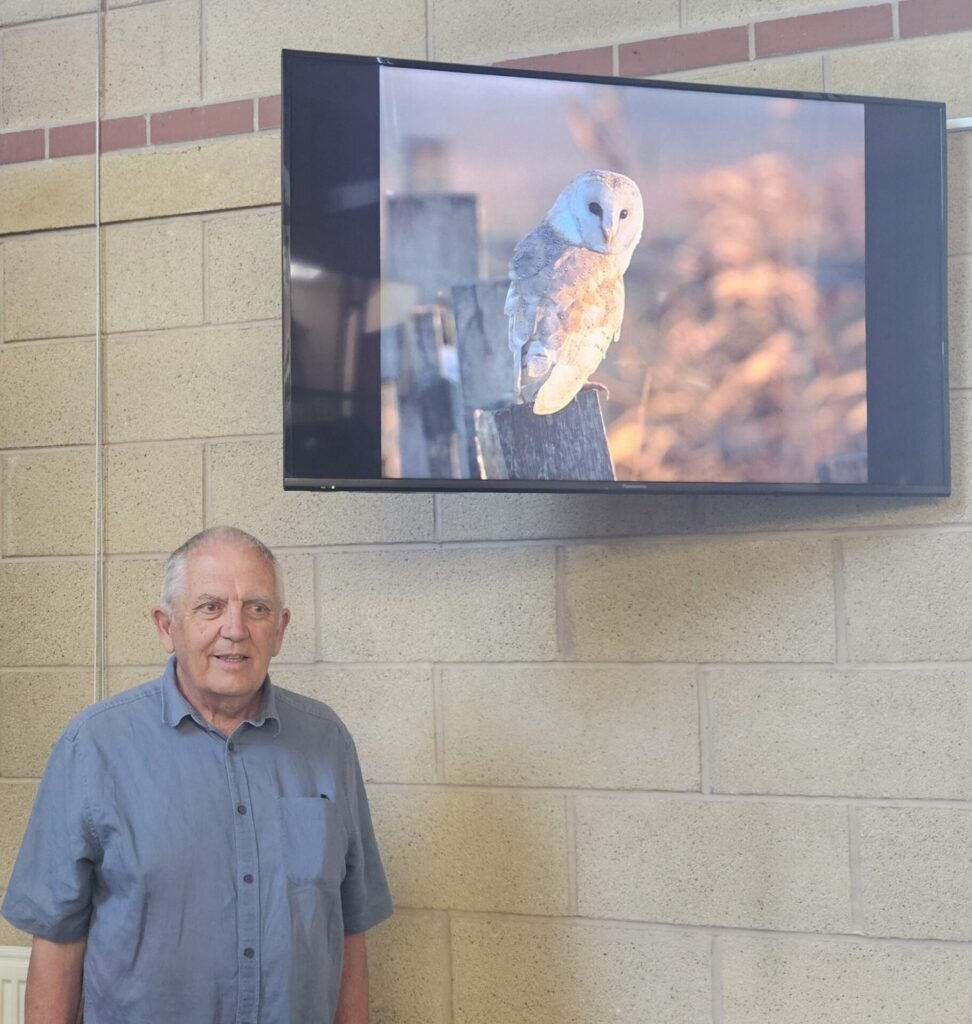
Another full house were treated to a very lively and informative talk by our very own David Tolliday who has been an RSPB Volunteer for over 35 years and regularly visits a number of sites in the UK including:
Pikelow Farm in Cheshire. The farm’s commitment to conservation provides a unique location for bird photography and observation with permanent hides and wildflower planted areas. Tree Sparrows nest in colonies and prefer their nests to be near water for insect food for their young. By providing multiple nest boxes near water Pikelow Farm has seen Tree Sparrow numbers increase from single figures to over 100.
Redesmere near Siddington- good for a winter visit for waterfowl.
The RSPB Coombes Valley Nature Reserve, Staffordshire where the pied Flycatcher is the signature visitor.
Gigrin Farm in mid Wales – a fantastic place to visit. The farm feeds Red Kites daily from a tractor. By 1883 only three birds were left in Wales, and none in England and Scotland. The Red Kites were thought to take lambs and so were shot. Now the Red Kites are commonplace in Wales and Southern England.
David shared with us advice on how to get the best photographs of birds. To get a more natural photograph try filling nooks and crannies in branches (or a drilled hole in a stick) with food and then wait! Robins love mealworms so try setting out food in a dish which can be gradually moved closer to where you want to take the photograph. Using this method David was able to get robins feeding on his patio, then a patio table and finally from his hand.
Goldfinches love Nyjer seeds. So to obtain the photograph of a goldfinch on a Teasel, David covered one side of the Teasel with Nyjer seeds and then took the photo from the other side.
With the advent of digital cameras, action shots are more popular although it may take 100 shots just to get one good one. To get a picture of a bird in flight try focusing midway between the feeder and the branch the bird is sitting on and then take multiple shots.
Observing behaviour can help you get the right picture. Trying (and failing) to get a shot of a bird jumping, David realised that the bird would lift its head just before jumping. By taking the photo just as the bird lifted it’s head he was able to capture the “jump”.
On what to feed birds, the current advice from the RSPB is that bread is ok as long as it’s part of a more varied diet. Defrosted frozen peas, sweetcorn and grain can also be used. Apparently, the bread scare emanated from a bird food manufacturer who had just released a new bird food and was trying to increase sales!
And next time you see Mallards – it’s the females that are noisy and the blue teal flash is there for a reason – it makes the bird look bigger in mating and threat displays.